Campgrounds in Cody Wyoming: the Best RV Parks and Free Camping Nearby
Published
- Cody: town parks 5,016 ft · mi 0
- Reservoir sites 5,370 ft · mi 9
- Wapiti 5,939 ft · mi 29
- Rex Hale 6,169 ft · mi 36
- Threemile 6,700 ft · mi 50
- East Entrance 6,951 ft · mi 52
Camping near Cody Wyoming breaks into three separate decisions. The campgrounds in Cody Wyoming itself, the state park on the reservoir, and the forest sites strung up the North Fork toward Yellowstone are separate propositions at different elevations and different distances from the park gate. Which of them counts as the best campgrounds in Cody Wyoming turns entirely on whether you came for the town, the water or the park. Pick the wrong one and you spend the trip driving.
The best campgrounds in Cody Wyoming for RV hookups
Three commercial parks handle the full-service end, and all three are inside or beside town.
Ponderosa Campground on 8th Street is the one with the location: 140 full-hookup sites on twenty acres, within walking distance of both downtown and the Cody Nite Rodeo. If the rodeo is why you came, this is the site that lets you leave the truck parked.
Absaroka Bay RV Park on Mountain View Drive has 81 full-hookup sites with 20, 30 and 50-amp service and pull-throughs, also inside the city.
Cody / Yellowstone East KOA sits just east of town on the Greybull Highway, with full hookups, a pool, laundry and a store.
The argument for all three is everything that is in town: the Buffalo Bill Center of the West, the restaurants on Sheridan Avenue and the rodeo grounds are minutes away, the nights at 5,016 feet are mild by regional standards, and the season is the longest of any option here. The argument against is that you are camping in a small town beside a road. Nothing about the setting is why you came to Wyoming.
For July and August, three to six months ahead is the normal booking window for these Cody WY campgrounds.
Camping near Cody Wyoming: the reservoir shoreline
Eight or nine miles west, past the tunnels and the dam, the road opens onto Buffalo Bill Reservoir, where the state park runs two campgrounds.
North Fork Campground is the larger, just under a hundred sites, 56 of them pull-through and six designated tent-only, with around thirty on electric hookups. It has showers, a dump station, a playground and a boat launch, and it runs May through September.
North Shore Bay Campground is the smaller and quieter at 37 sites: 29 pull-through, three back-in and five tent-only.
These are the obvious choice with a boat or a fishing rod, and the setting beats the town sites comfortably. The catch is exposure. There is almost no shelter on that shoreline and the wind comes off the water most afternoons with real conviction. That is a pitching problem, not a scenic one.
The forest campgrounds up the North Fork
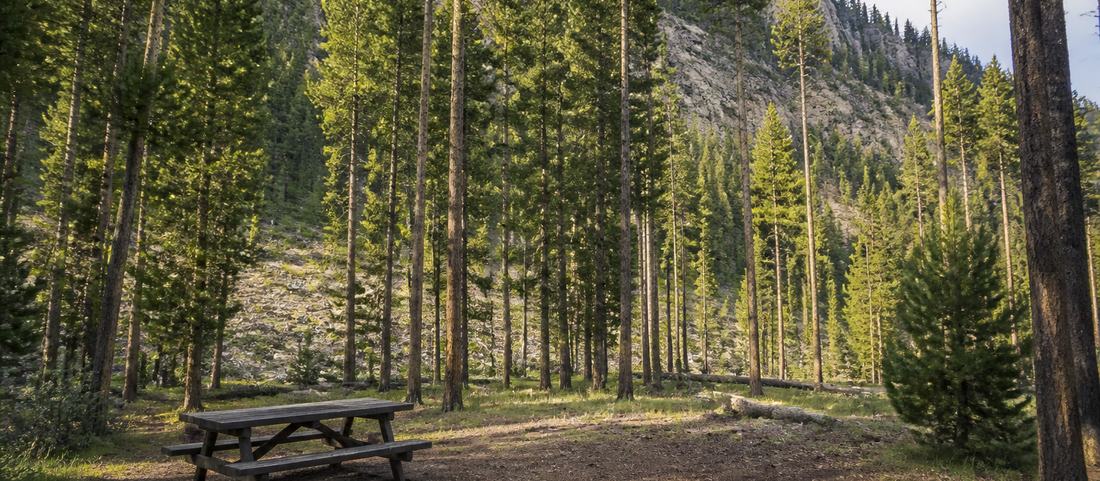
West of the reservoir the road enters Wapiti Valley and the Shoshone National Forest sites begin, spaced along the river for the next forty-odd miles. They have no hookups, they are simpler than anything in town, and they are in a completely different setting.
Working outward from Cody:
- Big Game, about 29 miles out at 5,915 feet, is the first and one of the smallest.
- Wapiti, at the same sort of distance and 5,939 feet, is the biggest of them at 41 sites.
- Elk Fork, 29 miles out at 6,000 feet, has 13 sites and doubles as the trailhead into the North Absaroka Wilderness.
- Clearwater, around 32 miles, has 32 sites.
- Rex Hale, about 36 miles at 6,169 feet, is the last one that takes tents.
- Eagle Creek, 45 miles out with 20 sites, is roughly eight miles from the park gate.
- Threemile, 50 miles out with 21 sites at 6,700 feet, is three miles from it.
For anyone whose objective is Yellowstone, the upper end of that list is the strongest option on this page. From Rex Hale the East Entrance is about twenty-five minutes away instead of an hour and a quarter, and that difference decides whether an early start into the park is realistic or merely intended.
The rule that catches tent campers
Eagle Creek and Threemile, the two campgrounds closest to Yellowstone, are hard-sided only. No tents, no pop-up campers. It is a grizzly-management requirement across the Wapiti Ranger District, not a house preference, and it comes with food-storage lockers at every site and an order covering food, drinks, coolers and trash.
The practical consequence is worth spelling out, because it is not obvious from a map: a tent camper aiming to be at the gate at opening cannot use the last fifteen miles of campgrounds. Tents stop at Rex Hale, 36 miles out. Anyone in a trailer or an RV can keep going to within three miles of Yellowstone.
Elevation is the variable nobody plans for
Cody sits at 5,016 feet. The reservoir shoreline is a few hundred feet higher. The forest sites climb from 5,915 at Big Game to 6,700 at Threemile, and the Yellowstone gate itself is at 6,951.
That is roughly seventeen hundred feet between the town parks and the top of the valley, and it translates directly into overnight temperature. A pleasant evening in Cody says very little about what the upper North Fork will do at four in the morning. A sleeping bag rated for the town is under-rated for the valley, and shoulder-season camping up there means genuinely freezing nights well outside what the calendar suggests. The altitude does not care that it is July.
Free camping near Cody Wyoming
Free camping near Cody Wyoming means dispersed camping in parts of Shoshone National Forest, and it is genuinely free. It is also genuinely undeveloped: no water, no toilet, no trash can, no table, and nobody to notice if something goes wrong. That is the trade, and it is a fair one for people equipped to make it. It is a poor one for anyone expecting a campground with the fee removed.
The rules matter more here than anywhere else on this page. The forest sets where dispersed camping is allowed, how long you may stay, how far from water and roads you must be, and how food must be stored, and those rules change. They need checking against current forest information, not against anything written down a season ago.
Bears, and what food storage actually means
Both black and grizzly bears range through the country west of Cody. The storage requirements are the defining rule of camping in the Shoshone, and they exist because of specific incidents.
In practice, food, cooking equipment, trash and anything else with a smell does not stay in a tent, and often may not stay loose in a vehicle either. Where lockers are provided, as at Threemile and Eagle Creek, they are provided for a reason. Where they are not, the responsibility transfers to you, and the accepted methods are set by the forest.
Two things are worth stating plainly. Cooking and sleeping are separate activities that happen in separate places. And a clean camp is not a courtesy to the next visitor: it is the mechanism that stops an animal learning that campgrounds contain food, which is the process that ends with the animal being destroyed.
Reserved or first-come
The commercial parks in town operate like accommodation. You book, you arrive, the site is yours, and in the week of the Stampede that predictability is the difference between having somewhere to sleep and not.
At North Fork Campground on the reservoir, sites can be reserved up to six months out. The forest campgrounds up the valley lean much more heavily on first-come, which changes how you plan the day: arriving late on a Friday in high season without a fallback is how people end up driving back down the valley in the dark. The ones who manage it arrive early and have a second site in mind before they need it.
Camping with an RV
The town parks are built for large rigs, with full hookups, pull-throughs, dump stations and the turning space to get in and out without a three-point turn on gravel.
Up the North Fork the constraint is physical, not regulatory. Sites have real length limits, access roads are narrower than they look on a map, and the turning areas were laid out for a different era of vehicle. A rig that handles Absaroka Bay comfortably may not fit at a site thirty miles up the valley, and finding that out at dusk is a bad evening. Confirm the individual site, not the campground, because within one forest campground the sites are rarely uniform. With no hookups, generator hours become a consideration, and those are set locally.
Camping in a tent
Tent camping here has two local complications beyond the hard-sided rule.
The first is wind, and the reservoir shoreline is where it bites: open water at altitude, with the breeze getting up most afternoons. Choose a pitch with some shelter and stake as though it will.
The second is the ground. This is dry, hard, stony country, and the surface at many sites will not take a lightweight stake driven by hand. Bringing something to hit them with is not excessive.
Against that, the compensations are real. The sky here is exceptionally dark once you are away from town, and the upper valley on a clear night is one of the better things about camping in this part of Wyoming.
Water, facilities and what “developed” means
The word developed covers a wide range. At the town end it means everything: potable water on the site, flush toilets, showers, laundry, waste disposal, power. At the forest end it can mean a pit toilet, a table, a fire ring and a hand pump, and at some sites the water is seasonal or absent entirely, which is a materially different trip.
Carrying water instead of assuming it is the local habit even at developed forest sites, because a hand pump out of service is a common and unremarkable event.
Fires
Fire restrictions are seasonal, they are set by the forest and the county, and they change within a single summer as conditions dry out. A fire ring at a site does not mean a fire is currently permitted in it. This is dry country with a long fire history, the restrictions are enforced, and in a bad year the answer is no for weeks at a time. Camp stoves are the reliable plan.
Season
Most Cody WY campgrounds are seasonal and nothing here runs year-round in any dependable way. The town parks open earliest and close latest, the state park runs May through September, and the upper forest campgrounds have the shortest season of all, with dates that move with the snow.
Choosing
Stay in town if the trip is about Cody: the best campgrounds in Cody Wyoming for services are all within a few minutes of Sheridan Avenue. Ponderosa if you want to walk to the rodeo, Absaroka Bay or the KOA otherwise.
Stay on the reservoir if you have a boat, or if you want a better setting than town without committing to the valley. Take the wind seriously.
Stay up the North Fork if the trip is about Yellowstone, as far up as your vehicle is allowed to go. In a tent that means Rex Hale; in anything hard-sided, Threemile.
Camp dispersed if you are equipped for it and want the country to yourself.
The one mistake worth naming is booking a town site and then driving to the park gate and back every day. That is two and a half hours of the same road daily, on a route that cannot be hurried, and it burns the two ends of the day the park is actually worth seeing.
If everything around Cody is full
This happens in one predictable week and one unpredictable circumstance. The predictable one is the Stampede around the Fourth of July, when accommodation of every kind across the whole area goes early. The unpredictable one is a closure: when a fire restriction, a road closure or weather takes a section of the forest out of use, the displaced traffic lands on whatever is still open.
Either way the answer is outward. Powell is twenty-four miles north-east and Meeteetse thirty-two miles south. Both are small, both are further from the park gate, and both are dramatically more likely to have space on a busy weekend. A site in Powell is a better night than an hour spent driving between full campgrounds at dusk.
The reservoir shoreline is worth a second look in this situation too. It is more exposed than the forest sites and less convenient than the town parks, which is exactly why it fills later than either.
Pets, groups and access
Dogs are ordinary at campgrounds here and the constraints are the usual ones: leashed, not left alone, and not taken onto trails where wildlife makes it a bad idea. The bear situation makes dog food exactly as much of a storage problem as human food, which is the part people forget.
Group sites exist at some campgrounds and are booked differently from individual pitches, usually further ahead and as a whole unit.
Accessible sites and facilities vary enough between the commercial parks and the forest campgrounds that they should be confirmed directly. The town parks are the better bet on level ground, surfaced paths and accessible restrooms. Forest sites range from reasonable to genuinely difficult, and it is the site-level detail that matters, not the campground’s overall description.
Common questions
What are the best campgrounds in Cody, Wyoming?
For services and a walk to the Nite Rodeo, Ponderosa Campground on 8th Street. For an early start into Yellowstone, Wapiti or Rex Hale up the North Fork. For the water, North Fork Campground in Buffalo Bill State Park. Those three answer almost every version of the question.
Which campground is closest to Yellowstone's East Entrance?
Threemile, about three miles from the gate and 50 miles from Cody, with 21 sites at 6,700 feet. Eagle Creek is next at roughly eight miles out. Both are hard-sided only, so neither is an option in a tent.
Is there free camping near Cody, Wyoming?
Dispersed camping is permitted in parts of Shoshone National Forest west of town, subject to the forest's current rules on where, how long and how food is stored. It is genuinely free and genuinely undeveloped: no water, no toilets, no trash cans. Check the current forest regulations before relying on it.
Can you camp at Buffalo Bill Reservoir?
Yes. Buffalo Bill State Park runs two campgrounds on the shoreline about eight miles west of town, North Fork with just under a hundred sites and North Shore Bay with 37. Both have a boat launch nearby and both are exposed to the afternoon wind off the water.
Do Cody WY campgrounds take large RVs?
The three commercial parks in town are built for them, with full hookups and pull-through sites. Up the North Fork the limits are physical: shorter sites, narrower access roads and turning areas laid out for smaller vehicles, so confirm the individual site, not the campground.