The Edge's Guitar Sound: the Tunings, the Delay Timing and the Gear, Album by Album
Published
- Signature
- Dotted-eighth delay
- Core amp
- Vox AC30
- Core guitar
- Explorer / Strat
- Approach
- Space over density
U2’s guitar parts are famously easy to play and famously difficult to sound like. The gap between those two facts is the whole subject, and it comes down to three things: the timing of a delay, the choice of tuning, and a willingness to leave space where most players fill it.
The dotted-eighth delay
The single most identifiable element is a dotted-eighth-note delay. The repeat lands three-quarters of the way through the beat and never on it, which means a straight eighth-note part played against its own echo produces a rhythmic pattern that neither the player nor the repeat is actually playing.
That is why transcriptions look sparse. A riff written as three notes can sound like six, because half of what the ear hears is the machine. Set the delay wrong and the same part played perfectly sounds like nothing in particular.
The timing has to track the tempo of the song, which is why the delay is set per song and not per guitar. It is closer to an instrument being tuned than to an effect being switched on.
Tunings
The second element is tuning. Dropped and open tunings recur throughout the catalog, and the purpose is consistent: to allow open strings to ring against fretted notes.
In standard tuning, playing a moving line usually means muting the strings around it. Retune so those strings belong to the chord and they can be left to sound, producing a drone underneath the melody. Much of what people describe as the “shimmer” is this: sustained open strings, not an effect.
The amplifier
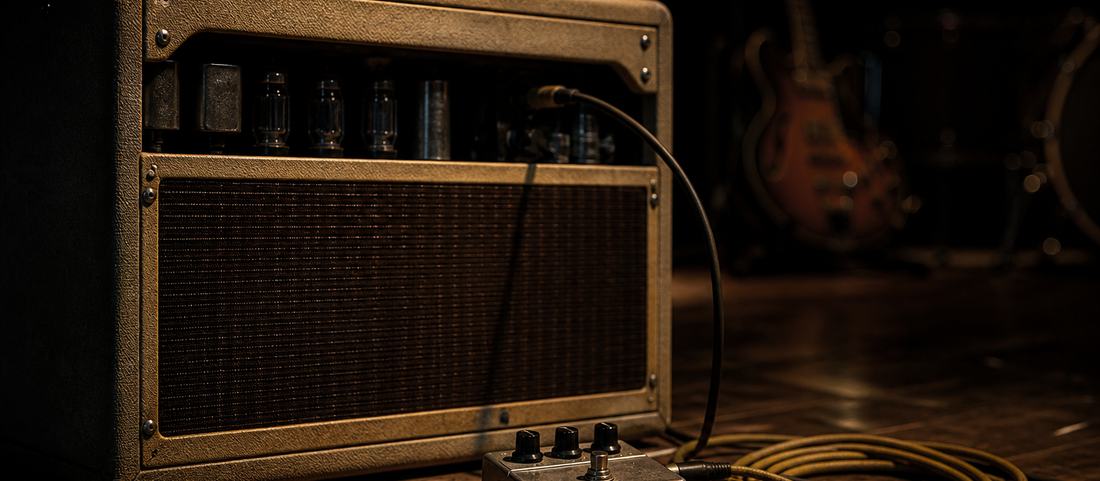
Before any pedal, there is a Vox AC30. Its natural top-end chime is a large part of the character, and it is the reason the clean sounds have presence instead of sitting politely behind the band.
The main guitars are a Gibson Explorer and a Fender Stratocaster, and the difference between them is audible across the records: the Explorer thicker and more resonant, the Stratocaster sharper and more percussive.
What changes between records
The early albums are the method at its most exposed: single notes, a lot of space, delay doing the arrangement. Through the mid-eighties the sound widens: more reverb, more sustain, parts written to sit under a landscape, never in front of one.
The early-nineties records deliberately break it. Distortion, deliberate ugliness, processing used to obscure, not to clarify. It is the same player working against his own signature on purpose.
Later records move back toward the cleaner chime, but with the intervening decade’s willingness to distort still available.
The effect changes what gets played
A repeat that arrives three-sixteenths of a beat behind the note does something specific to the person playing: it fills the space, which means the space has to be left. Play a busy line into that setting and it turns to mud, so the writing moves in the opposite direction: fewer notes, picked deliberately, with the rhythm emerging from the gap between what is played and what comes back.
That is the part that resists imitation. The sound can be dialled in on any modern unit in a few minutes; the restraint it requires is the actual technique, and it shows up as much in what is absent from a part as in what is in it.
Why it is hard to copy
Because the parts are not the sound. Learn the notes and you have perhaps a third of it. The rest is a delay set to the song’s tempo, a tuning chosen so specific strings can ring, an amplifier with a particular top end, and the discipline to play far less than the song appears to contain.
None of which is an argument that the sound is simple. It is an argument that the difficulty is in the decisions, not the equipment.
Common questions
What delay setting does The Edge use?
The signature is a dotted-eighth-note delay: the repeat falls three-quarters of the way through a beat instead of on it. Played against a straight eighth-note part, the guitar and its own echo interlock into a pattern neither is playing on its own. That is the sound on most of the well-known riffs.
What tunings are used on U2 songs?
A mixture of standard, dropped and open tunings. The purpose is generally to let open strings ring against fretted notes, producing a drone underneath the melody that standard tuning would require muting.
What guitar and amp make that sound?
The core combination is a Vox AC30 amplifier with a Gibson Explorer or a Fender Stratocaster, plus the delay units. The amp's natural chime is a substantial part of the character before any effect is added.
Why does the guitar sound so simple written down?
Because it is. The complexity is in the rhythm and the processing, not in the notes. A part transcribed as three notes can sound like six once a dotted-eighth repeat is interleaved with it.
How did the sound change between albums?
Broadly: sparse and delay-led on the early records, wide and atmospheric through the mid-eighties, deliberately distorted and processed on the early-nineties albums, and a return to the cleaner chime later. The underlying method stayed constant.