Bull Riding and the Bighorn Rodeo Country Near Cody, Wyoming
Published
- Country
- Bighorn Basin
- Arenas
- One per town
- Cody
- Nightly, all summer
- Elsewhere
- Once a year
Wyoming bull riding is not confined to the arena that sells tickets to it. The Bighorn Basin has rodeo in more or less every town it has, and Cody’s nightly show sits on top of a much older and more scattered habit.
Bull riding, in one paragraph
The clock starts when the bull’s shoulder clears the chute and the ride qualifies at eight seconds. The score is split between the rider and the animal, which is why a clean ride on a dull bull beats nothing and loses to a scrappy one on a great bull. That is the whole event, and how it works in detail is its own page. It closes the running order at the Cody Nite Rodeo, so anyone leaving early misses the thing they came for.
Why the basin has so many arenas
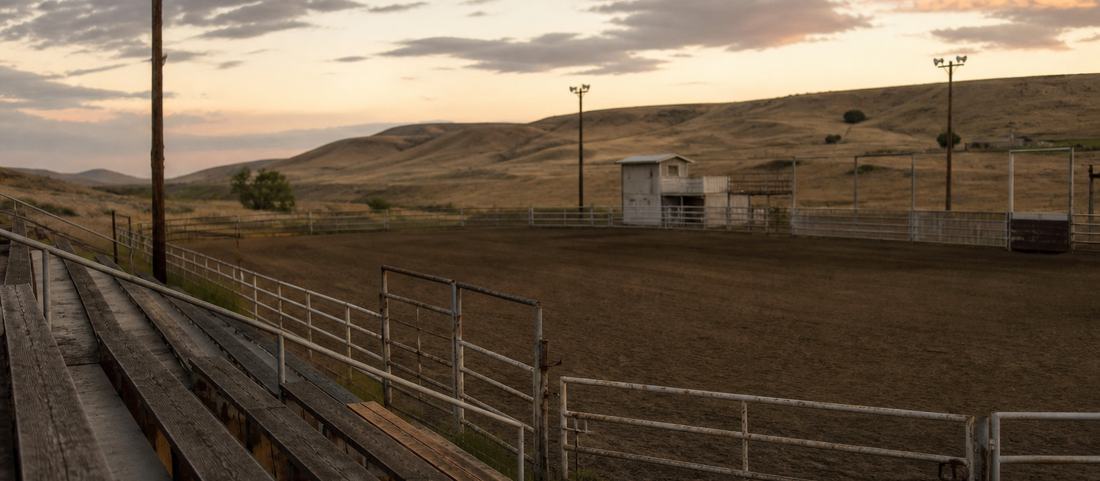
Rodeo is thick on the ground here for a reason that has nothing to do with tourism. This is ranching country with towns a long way apart, and for a century the county fair and the summer rodeo have been what a scattered population does instead of having somewhere to go on a Saturday. The arenas came first and the spectators came second.
That history is why the standard of the riding at a small basin rodeo can be surprisingly high. The competitors are frequently the same people, moving between arenas across a season, and a rodeo that looks like a local event on the poster is often drawing from the same regional pool as the one in the next county.
The towns that hold them
The basin is a ring of small towns around a dry floor, and the drive between any two of them is long enough that each keeps its own arena. Powell is twenty-four miles north-east of Cody and Meeteetse thirty-two miles south. Beyond them the basin runs out to Lovell and Greybull on the north and east sides, Basin and Worland down the middle, and Thermopolis at the far southern end, better known for its hot springs than its stock.
None of that is a schedule, and it deliberately is not one: these are county-fair fixtures whose dates move, and the only reliable way to find one is to ask in town during the week you are there.
What actually differs between arenas
The events are the same and the rules are the same. What changes is scale and surface. A larger arena gives a bull more room to turn and a rider a longer fall; the state of the dirt after a wet week changes how the timed events run; and lighting decides how much a spectator can actually see of the eight seconds. None of that is announced, and all of it is visible once you know to look.
The other variable is the crowd. At Cody a good proportion of the stands is seeing its first rodeo, and the announcer works accordingly, explaining the rules as the evening goes. At a county rodeo almost nobody needs that, so nobody says it, and a visitor is left to follow along.
Cody against a county rodeo
What distinguishes Cody is frequency and continuity, not scale: a nightly performance through the summer, in the same arena, over generations. That is what makes it part of the town’s routine instead of an annual event the town prepares for.
For a visitor the practical consequence is choice. A summer week in the basin will usually contain more than one rodeo within an hour or two of Cody, and they are not interchangeable experiences. A nightly show built for a steady flow of visitors and a once-a-year county event where most of the crowd knows most of the competitors are different evenings out. The second is harder to find, and frequently the one people remember.
Common questions
Where can you see bull riding near Cody?
It closes the Cody Nite Rodeo every evening through the summer season at Stampede Park, and features at the Cody Stampede around the Fourth of July. Smaller arenas across the Bighorn Basin run their own rodeos through the same months.
Is a small county rodeo worth going to instead?
If you can find one, yes, and the standard is often higher than the poster suggests. The competitors move between arenas across a season, so a local event frequently draws from the same regional pool as the next county's.
How is Wyoming bull riding scored?
In two halves, rider and animal, added together. The event page has the detail; the short version is that the draw matters as much as the ride.
What actually differs between one basin arena and another?
Scale and surface, not the rules. A larger arena gives a bull more room to turn and a rider a longer fall, dirt that has taken a wet week changes how the timed events run, and the lighting decides how much of the eight seconds a spectator can see. None of it is announced from the box.