Rodeo Clowns and Bullfighters at the Cody Nite Rodeo: Two Jobs, Not One
Published
- Roles
- Two, distinct
- Bullfighter
- Rider protection
- Clown
- Crowd, between events
- Risk
- Genuine
The painted figures in the arena at the Cody Nite Rodeo are doing two entirely different jobs, and the distinction is worth knowing before you watch a ride.
The bullfighter
When a rider comes off a bull, someone has to make the animal look somewhere else, immediately and at close quarters. That is the bullfighter. They work in pairs or threes, position themselves before the ride starts, and move in the moment the rider is down.
It is skilled work performed at speed and it carries real risk. Every element of it is about buying a rider on the ground two or three seconds to get up and out.
The clown
Between events there are gaps: stock to move, chutes to reset, times to record, and somebody has to hold several thousand people’s attention through them. That is the clown’s job, and it is performance, not protection.
Why they get confused
The costume is shared, and at smaller rodeos one person often does both. The result is that a role built around protecting people from serious injury is widely assumed to be comic relief. Watching a single ride with the distinction in mind makes the arena read completely differently.
The barrel
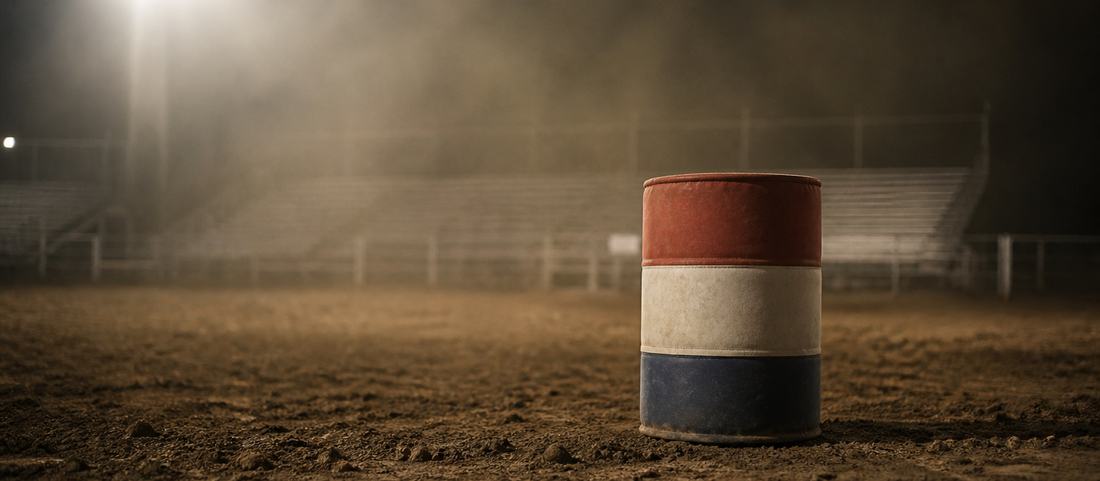
The padded barrel in the middle of the arena is working equipment. A bullfighter can put it between themselves and an animal, or get inside it, and it gives the crowd a fixed point to watch during the disorder after a rider comes off.
It is also the origin of the barrel man as a distinct role at larger rodeos: someone who works from the barrel, handles the comedy, and remains available as a diversion if a ride goes badly. The prop is genuinely protective, which is why it stays in the arena even at rodeos that do no comedy at all.
Moving it a few feet at the right moment is a tactical act first, even when it is played for laughs. The reason the two jobs travel together at all is timing: both depend on reading an animal a beat before it does anything, and someone who can do that during a ride can also do it in the gap between rides, when the crowd needs holding and the arena crew needs ninety seconds.
What the bullfighter is actually doing
From the stands it looks like distraction. It is closer to geometry. The bullfighter works the angle between the animal’s head and the rider on the ground, taking the shortest line that puts himself where the bull’s attention already is, and he wants the animal to follow him in the direction it was already turning instead of reversing it. The best of them barely appear to hurry.
The gear is chosen for the same reason a sprinter’s is: cleats for grip on turned dirt, loose shorts over a protective vest so nothing catches on a horn.
Reading the arena
Once a ride ends, watch the bullfighters, not the rider. Their positioning tells you what the bull is doing before the crowd noise does, because they move to intercept a line the animal has not committed to yet. It is the clearest demonstration in the arena of people reading an animal faster than spectators can.
It is also worth knowing that the protective side of the job has professionalized considerably. What used to be a role filled by whoever was willing is now specialized work with its own training, its own equipment standards and, at the top of it, its own competitions. The comedy has not gone anywhere, but the two halves have drifted apart, and at larger rodeos they are simply two different people.
Common questions
What is the difference between a rodeo clown and a bullfighter?
The bullfighter's job is to protect a thrown rider by drawing the animal away, at close range and at speed. The clown's job is to entertain the crowd between events. The same person sometimes does both, which is why they are often confused.
Is being a rodeo bullfighter dangerous?
It is the most dangerous role in the arena. Bullfighters deliberately put themselves between a loose bull and a rider on the ground.
Do rodeo clowns and bullfighters get paid the same?
They are separate jobs with separate pay, even when one person does both at a smaller rodeo. The protective work has its own training and equipment standards, and at larger rodeos it is a specialist role held by a different person.
What is the barrel for?
It is padded steel and it is protective equipment. It gives whoever is inside somewhere a bull can hit without consequence, and gives the animal something to commit to that is not a person.