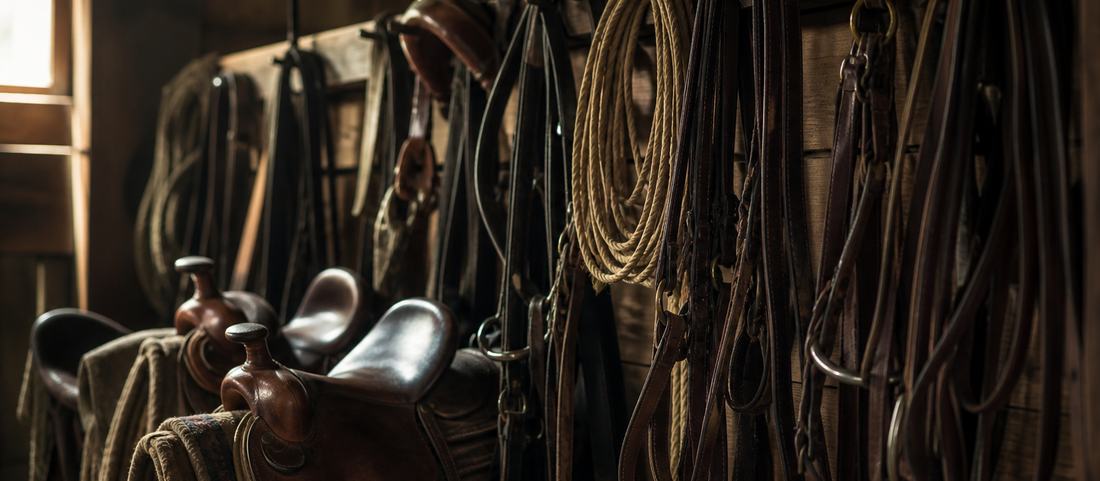
Cowboy Tack and Rodeo Equipment: the Bareback Rig, the Bronc Saddle and the Ropes
Published
- Bareback
- Rigging handle
- Bronc
- Assoc. saddle
- Bull
- Braided rope
- Regulated
- Yes
Rodeo equipment is minimal, specific and heavily regulated, and knowing what each piece does explains why the events look the way they do.
Bareback rigging
A leather pad cinched onto the horse, carrying a rigid handle rather like a suitcase grip. There is no rein and there are no stirrups. The rider holds the handle with one hand and has nothing else. That accounts for the distinctive laid-back position: with no way to brace forward, the only stable posture is backwards.
The bronc saddle
Saddle bronc uses a standardized association saddle with no horn, plus a thick rein attached to the halter. The specification is common across the sport deliberately, so competitors are compared on riding alone.
Why gear is worn in and not bought new
A rider’s rigging or rope is personal in a practical sense, not a sentimental one. Leather and braided rope both take a shape from use, and the shape is specific to the hand and the grip that made it. A new rope has to be worked before it is trustworthy, which is why competitors carry their own and do not borrow, and why a lost bag is a genuine setback and not a shopping trip.
Bull rope
A flat braided rope that passes around the bull’s girth with a woven handhold. It is not tied to the rider; the grip is maintained by hand pressure and by wrapping the tail of the rope across the palm, which is why a rider can be released from it when things go wrong, and occasionally cannot.
The flank strap
Fitted around the animal’s flank, lined with sheepskin, and adjusted to encourage the animal to kick out behind instead of forward. It is commonly and wrongly assumed to work by causing pain to the genitals; it does not touch them. It is released the moment the ride ends, which is why the animal usually stops bucking within a stride or two of the horn.
The spurs
Spurs are equipment, not punishment, and the rules treat them that way: the rowels a competitor wears in a professional arena are dulled, so they grip hide the way a rubber sole grips a floor. What they are for is scoring. In the riding events a judge is watching where the spurs are and what they are doing, so a rider who could stay aboard without using them still uses them, because the mark depends on it.
Who owns which piece
The split is not obvious from the stands. Everything against the rider’s body is his own: spurs, glove, chaps, vest, and the rigging or rope he has usually worn in for years and would not lend. Everything against the animal belongs to the contractor, including the flank strap and the chute gear, and it is set and released by the contractor’s people, not by the competitor.
That division matters when something fails. A rope that breaks is the rider’s problem and his score; a flank strap that comes loose mid-ride is the stock’s problem, and the judges can offer the ride again.
Rosin and grip
Riders work rosin into the glove and the rope before a ride, and the heat of pulling the rope through a gloved hand melts it enough to make the grip tacky. It is a small detail and it is the difference between a handhold that holds and one that does not.
The same principle explains the delay in the chute that spectators sometimes read as nerves. A rider settling onto an animal is setting the rope, working the grip and finding a position, and that work has to be done properly because there is no adjusting it afterwards.
Common questions
What is a bareback rig?
The bareback rider's only equipment: a cinched pad with one rigid grip on it. One hand, no stirrups, no rein, and nothing to brace against.
What is the flank strap for?
It is a sheepskin-lined strap fitted around the animal's flank that encourages it to kick out behind instead of running. It is not fitted to the genitals, a persistent misconception, and it is released as soon as the ride ends.
Are rodeo spurs sharp?
No. The rowels used in a professional arena are dulled, so they grip hide without cutting it. They are scoring equipment: a judge is watching where the spurs are and what they are doing throughout the ride.
Whose equipment is whose?
Everything against the rider is his own: spurs, glove, chaps, vest, rope or rigging. Everything against the animal, including the flank strap, belongs to the stock contractor and is handled by the contractor's people.