Pickup Men at the Rodeo: the Mounted Riders Who Collect the Broncs
Published
- Role
- Mounted
- Events
- Bronc riding
- Job
- Collect rider, clear stock
Two mounted riders sit at the edge of the arena through every bronc event at Cody, and most of the crowd never registers what they are for.
The job
When a saddle bronc or bareback ride reaches eight seconds, the rider still has to get off a horse that has not finished bucking. The pickup men ride in alongside, take the rider off onto their own horse or onto the ground safely, then get the bronc moving toward the gate and out.
Why it goes unnoticed
Because when it is done well, nothing appears to happen. The horn sounds, the rider is somehow on the ground and upright, and the horse is somehow leaving. The skill is entirely in making a difficult piece of horsemanship look like an absence of event.
Not in bull riding
Pickup men work the horse events only. A bull cannot be managed from horseback in the same way, which is why bull riders are protected on foot by bullfighters instead. The two roles are often confused and are not interchangeable.
The other half of the job
Collecting the rider is the visible part. The rest of it is stock: the pickup men take the flank strap off the horse while it is still moving, which is what stops the bucking within a stride or two, and then steer the animal out of the arena and into the gate without a fuss. A performance that runs to time depends on that being done quickly and without drama, which is why it is done by riders who have been doing it for years.
They also work for the contractor and not for the rodeo. Their job is the animals as much as the cowboys, and the two responsibilities are the same responsibility: an animal that leaves the arena calmly is one that can work again tomorrow night.
The horses
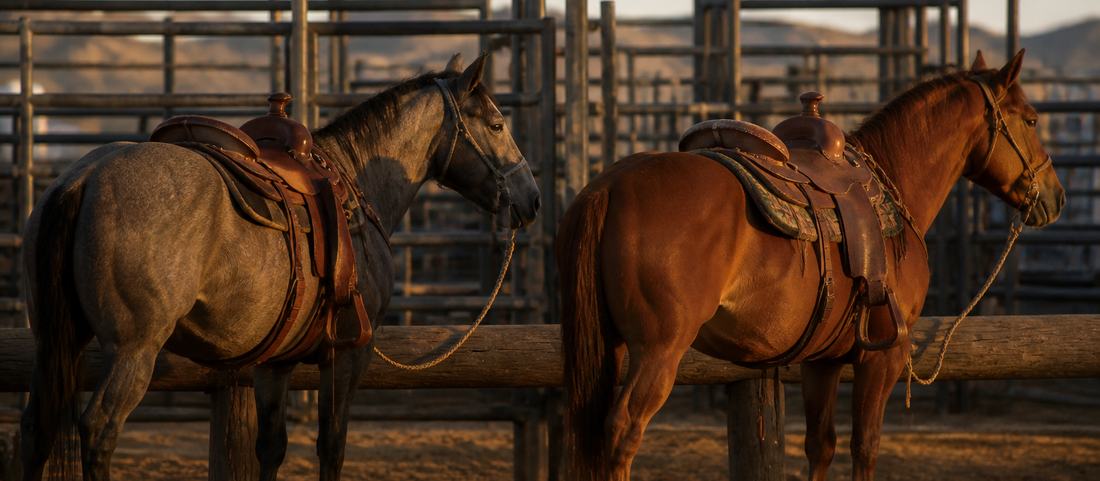
Pickup horses are as specialized as anything else in the arena. They have to run alongside an animal that is bucking hard, hold a line while a rider transfers across, and stay calm in the middle of noise and movement that most horses will not tolerate.
They are typically large, experienced and unhurried, and a good one is worth a great deal. Watch the horse instead of the rider during a pickup and the skill involved becomes much more obvious.
Two riders, always
Pickup men work in pairs and the pairing is deliberate. One takes the rider, the other takes the horse, and which does which depends on how the animal is moving when the horn sounds. Working out that division in the second available is the part of the job that experience buys.
Arriving too early has a price
The pickup men are not meant to touch the horse until the eight seconds are up, and the rulebook puts a cost on getting that wrong. If arena personnel make contact with a bronc before the qualified time has elapsed and the rider still completes the ride, he keeps the score and may take a re-ride instead. If the contact is what stopped him qualifying, he gets the re-ride outright, provided he was riding cleanly up to the point of the interference.
So the job is squeezed at both ends. Too late and the dismount turns into a bad landing; too early and the ride has to be run again, with a fresh animal and a fresh draw.
When a rider hangs up
The situation the pickup men exist for is the one nobody wants to see. If a bronc rider’s hand does not come free of the rigging, he is attached to a running animal and on the wrong side of it, and the seconds involved are very few. Both riders converge — one to bring the horse’s head around and slow it, one to get alongside the rider and free the hand.
It is the clearest argument for having two of them instead of one, and for keeping them mounted. Nothing else in the arena can match a running horse’s pace closely enough to work on it.
Where to watch from
The pickup happens at the far end of the arena more often than not, because that is where a bronc ends up after eight seconds. Seats toward that end trade a poor view of the chute for a good view of the part of the event most people never actually see properly.
Common questions
What do pickup men do at a rodeo?
They ride alongside a bucking horse at the end of a qualified ride, take the rider off, and then move the horse out of the arena. They work the bronc events, not bull riding.
Why are pickup men not used in bull riding?
A bull will not be handled from horseback the way a bronc will. Bull riders are protected by bullfighters on foot instead.
Do pickup men compete?
No. They are contracted to work the performance, not entered in it. Many are former competitors, and at smaller rodeos the same riders do the job all season.
How do riders get off if the pickup goes wrong?
They come off themselves, which is why bronc riders practice dismounting as much as riding. A missed pickup is a bad landing, though not usually a disaster, but it is the outcome the job exists to prevent.